October 24, 2025:
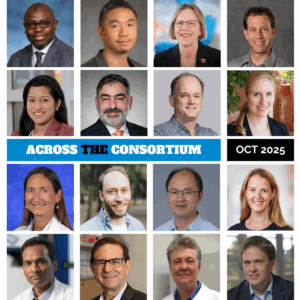
In this month’s Across the Consortium, the Big Ten Cancer Research Consortium highlights examples of discovery and impact from our member institutions. This issue covers a broad range of efforts to advance cancer research and care, from pioneering clinical trials and artificial intelligence diagnostics to novel immunotherapies, personalized treatments, and community-focused initiatives across Big Ten CRC member institutions.
University of Illinois Cancer Center
On October 3, the 2025 Dr. Tapas Das Gupta Cancer Research Symposium was held with a focus on “Cancer Health Equity from Previvor to Survivor.” The event opened with a welcome address from Jan Kitajewski, PhD, Director of the University of Illinois Cancer Center and Sweeney Professor of Basic Sciences and Head of the Department of Physiology and Biophysics at the University of Illinois College of Medicine at UIC and featured speakers from community organizations and academic medical centers, including Phyllis L. Rodgers, Callisia N. Clarke, MD, Christina Bailey, MD, and Andrew Hung, MD. Presentations explored patient advocacy, equitable care, AYA colorectal cancer, and the role of artificial intelligence in surgery.
Read more: https://cancer.uillinois.edu/news/2025-das-gupta-cancer-research-symposium
Cancer Center at Illinois
Michael Oelze, PhD, professor of bioengineering and member of the Cancer Center at Illinois, is leading a $2.6 million federally funded effort to develop ultrasound technologies that can deliver faster diagnostic imaging. Supported by multiple NIH grants, Dr. Oelze and collaborators are engineering affordable 3D volumetric ultrasound systems and advancing vascular imaging techniques to broaden research access and improve diagnosis.
Indiana University Melvin and Bren Simon Comprehensive Cancer Center
Research led by Kai Yang, PhD, at Indiana University School of Medicine revealed that the cancer-fighting gene STK11 also regulates immune cells that can aid tumor growth. Published in Science Advances, the study found that loss of STK11 in macrophages accelerates pancreatic cancer progression, pointing to new strategies for improving treatment.
Read more: https://medicine.iu.edu/news/2025/09/genes-role-pancreatic-cancer-tumor-growth
University of Iowa Holden Comprehensive Cancer Center
UI Health Care researchers are testing a novel immunotherapy that uses a modified herpes virus to turn tumors against themselves. Led by Mohammed Milhem, MB, BS, the study combines the viral therapy RP1 with nivolumab, showing promising results for patients with advanced melanoma and sarcoma and positioning Iowa at the forefront of immune-based cancer treatment.
University of Maryland Marlene and Stewart Greenebaum Comprehensive Cancer Center
The University of Maryland Marlene and Stewart Greenebaum Comprehensive Cancer Center joined 61 other NCI-designated cancer centers in endorsing a national statement supporting HPV vaccination as a proven cancer prevention measure. HPV causes more than 40,000 cancers annually in the U.S., yet vaccination rates remain below national goals. Executive Director Taofeek K. Owonikoko, MD, PhD, emphasized that timely vaccination can prevent 90% of HPV-related cancers.
Read more: https://www.umms.org/umgccc/news/2025/umgccc-supports-hpv-vaccination
University of Michigan Rogel Cancer Center
Researchers at the University of Michigan Health Rogel Cancer Center identified a new way to disrupt prostate cancer growth by targeting key enhancer proteins that drive tumor-promoting genes. Led by Arul Chinnaiyan, MD, PhD, the team developed CBPD-409, a compound that selectively degrades proteins critical to androgen receptor signaling. The treatment, published in Nature Genetics, effectively suppressed tumor activity in preclinical models and offers promise for treating castration-resistant prostate cancer.
Michigan State University Cancer Research
Michigan State University researchers have developed a shampoo-like gel that may help prevent hair loss during chemotherapy. Led by Bryan Smith, PhD, of the College of Engineering, the study published in Biomaterials Advances describes a temperature-responsive hydrogel that restricts blood flow to the scalp, reducing chemotherapy drugs’ impact on hair follicles. The gel offers a potential alternative to current cold cap methods and could significantly improve the quality of life for patients undergoing treatment.
Read more: https://msutoday.msu.edu/news/2025/09/shampoo-like-gel-could-help-chemo-patients-keep-their-hair
Masonic Cancer Center, University of Minnesota
Researchers at the Masonic Cancer Center, University of Minnesota, found that COVID-19 can persist in the intestinal tissue of some cancer patients long after nasal tests come back negative. The study, published in iScience, examined transplant-treated cancer patients who experienced severe inflammation following COVID-19 infection. Justin Hwang, PhD, and Emil Lou, MD, PhD, noted that the virus remained active in the gut for up to six weeks, triggering tissue damage and elevated levels of the protein SERPINA1, which may serve as a marker of inflammation risk. These findings could help clinicians identify patients who need closer monitoring and determine when they are ready to safely continue cancer treatments.
Read more: https://cancer.umn.edu/news/covid19-in-cancer-patients-2025
Fred & Pamela Buffett Cancer Center (University of Nebraska)
Joann Sweasy, PhD, director of the Fred & Pamela Buffett Cancer Center, has begun her two-year term as president of the Association of American Cancer Institutes (AACI). Dr. Sweasy plans to focus on improving cancer care in rural areas, where patients face higher rates of morbidity and mortality due to limited access to prevention, treatment, and clinical trials. Her initiative will map access to services, study social determinants of health, share best practices across NCI-designated cancer centers, and develop an oversight committee to guide ongoing efforts.
Read more: https://www.unmc.edu/newsroom/2025/10/22/joann-sweasy-phd-to-serve-as-president-of-aaci/
Robert H. Lurie Comprehensive Cancer Center of Northwestern University
Northwestern University scientists have discovered a new mechanism for the formation of paraspeckles, nuclear structures involved in gene regulation and linked to cancer progression. Wilton Snead, PhD, led the study, showing that proteins in paraspeckles compete for the same RNA region, creating the structures’ spatial organization. This molecular insight could inform future drug development targeting paraspeckles and other cellular condensates involved in cancer.
The Ohio State University Comprehensive Cancer Center – James Cancer Hospital and Solove Research Institute
Arya Roy, MD, is using artificial intelligence to study invasive lobular breast cancer, a form that can be hard to detect on mammograms. Her team’s research analyzes digital tumor images alongside patient health data to identify biomarkers that predict cancer recurrence, aiming to help clinicians detect this aggressive cancer earlier and guide treatment decisions.
Read more: https://health.osu.edu/discovery-and-innovation/research-advances/ai-detects-lobular-breast-cancer
Penn State Cancer Institute
Giselle Sholler, MD, MSc, chief of the Division of Pediatric Hematology and Oncology at Penn State Health Children’s Hospital and founder and chair of the Beat Childhood Cancer Research Consortium, is leading a national clinical trial for children and young adults with high-risk cancers, including neuroblastoma, central nervous system tumors, and sarcomas.
Purdue University Institute for Cancer Research
John Tesmer, PhD, Walther Distinguished Professor in Cancer Structural Biology at Purdue University and a member of the Purdue Institute for Cancer Research, is leading work that could unlock new ways to control cancer metastasis. His team’s recent Nature publication decodes how atypical chemokine receptor 3 (ACKR3) interacts with cellular signaling proteins that guide immune response and cancer cell migration. By revealing how subtle molecular “barcodes” influence these interactions, the study offers insights into how researchers might one day halt tumor spread without disrupting healthy immune function.
Rutgers Cancer Institute
Lindsay Potdevin, MD, surgical oncologist in the Breast Cancer Program at Rutgers Cancer Institute and RWJBarnabas Health, is raising awareness about rising breast cancer rates among young women. She emphasizes that younger women are increasingly being diagnosed and should be proactive about understanding their risks and recognizing early warning signs. Through initiatives like the Hereditary Oncology Prevention and Evaluation (HOPE) High Risk Clinic at the Jack & Sheryl Morris Cancer Center, Rutgers Cancer Institute and RWJBarnabas Health are helping women assess genetic and familial risk factors and develop personalized prevention and screening plans.
Read more: https://cinj.org/expert-shares-what-young-women-need-know-about-breast-cancer
Fred Hutchinson Cancer Center (University of Washington)
Heather Parsons, MD, MPH, has joined Fred Hutch Cancer Center as head of the Breast Oncology Program and was named the Maudslien Endowed Chair in Breast Cancer Precision Oncology Research. Formerly of Dana-Farber Cancer Institute, Dr. Parsons focuses on liquid biopsy and circulating tumor DNA (ctDNA) as tools to detect, monitor, and personalize treatment for breast cancer. In her work, she aims to advance early detection and precision therapy through minimally invasive blood-based testing, helping bridge the gap between lab science and clinical care at Fred Hutch.
Read more: https://www.fredhutch.org/en/news/center-news/2025/10/heather-parsons-breast-cancer-initiatives.html
University of Wisconsin Carbone Cancer Center
Jenny Gumperz, PhD, at the UW Carbone Cancer Center, is investigating how invariant natural killer T (iNKT) cells and dendritic cells can work together to restart the immune system’s ability to target cancer. Her research aims to develop immunotherapies that activate a targeted anti-cancer response without causing widespread inflammation, with a current focus on preventing ovarian cancer relapse. Through partnership with the Wisconsin Alumni Research Foundation (WARF), Dr. Gumperz is advancing preclinical studies and exploring commercialization pathways to bring this approach closer to patient care.
About the Big Ten Cancer Research Consortium:
The Big Ten Cancer Research Consortium was created in 2013 to transform the conduct of cancer research through collaborative clinical trials and observational studies that seek to improve the lives of cancer patients in the diverse communities we serve by leveraging the scientific and clinical expertise of Big Ten universities. The Big Ten Cancer Research Consortium creates a unique team research culture to drive science rapidly from ideas to treatment and prevention. Within this innovative environment, today’s research leaders collaborate with and mentor the research leaders of tomorrow. Since its founding, the Big Ten CRC has activated nearly 40 clinical trials across a wide range of cancer types, more than 1,000 participants have enrolled in Big Ten CRC studies, and more than 500 researchers have joined Big Ten CRC Clinical Trial Working Groups.
About the Big Ten Conference:
The Big Ten Conference is an association of world-class universities whose member institutions share a common mission of research, graduate, professional, and undergraduate teaching, and public service. Founded in 1896, the Big Ten has sustained a comprehensive set of shared practices and policies that enforce the priority of academics in the lives of students competing in intercollegiate athletics and emphasize the values of integrity, fairness, and competitiveness. The broad-based programs of the 18 Big Ten institutions provide direct financial support for more than 11,000 participation opportunities on 350 teams in 42 different sports. The Big Ten sponsors 28 official conference sports, 14 for men and 14 for women. For more information, visit www.bigten.org.



Subscribe to the Big Ten CRC Newsletter X
X Facebook
 YouTube