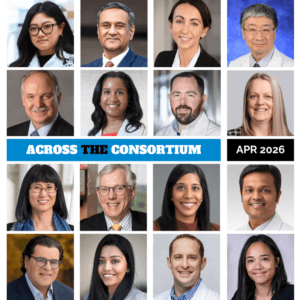
April 21, 2026: In this edition of Across the Consortium, we pause to recognize recent significant milestones and research accomplishments by our member institutions. From a prestigious NCI designation that will accelerate research advances from the lab to the clinic, to grant funding that will transform the way health care is delivered around the world, to research awards that will help early-career investigators launch new avenues for discovery, and due honor for those whose work has influenced international guidelines, there is much to celebrate from New Brunswick to Seattle and all points between.
University of Illinois Cancer Center: Studying the body’s smallest bacteria gave University of Illinois Chicago researchers an idea for how to catch lung cancer at its source. Led by University of Illinois Cancer Center researcher and UI Health oncologist Frank Weinberg, MD, PhD, the scientists looked at lung cells and fluids from 20 cancer patients. They noticed the patients’ lungs shared a unique combination of molecules. That combination, they realized, is a telltale warning sign that can help them detect, treat and, perhaps, even prevent lung cancer in its earliest stages. Read more.
Cancer Center at Illinois: The Cancer Center at Illinois (CCIL) announced it has been designated as a Basic Cancer Center by the National Cancer Institute. This national recognition places CCIL among the nation’s most elite cancer research institutions and affirms the University of Illinois Urbana-Champaign’s excellence in merging oncology, engineering, and basic science. Read more.
Indiana University Melvin and Bren Simon Comprehensive Cancer Center: The Indiana University Melvin and Bren Simon Comprehensive Cancer Center has been awarded a $5 million grant from The Pfizer Foundation to expand access to timely breast cancer diagnosis, treatment and care in Kenya. The three-year grant will support the work of AMPATH — the Academic Model Providing Access to Healthcare partnership — which includes Moi University and Moi Teaching and Referral Hospital in Kenya, and the Center for Global Oncology at the IU Simon Comprehensive Cancer Center, the IU School of Medicine and the IU Center for Global Health in Indiana. Read more.
University of Iowa Holden Comprehensive Cancer Center: Colin Kenny, PhD, has won three major awards in recent months. But if you ask him what he is most proud of, he will tell you about the PhD students in his lab. At the PanAmerican Society for Pigment Cell Research Meeting in Tampa this past March, Dr. Kenny was honored with the Medrano Young Investigator Award. Remarkably, at the same conference, every member of his lab also came home with an award. Three PhD students working in his group — Delaney Robinson, BA, MPH; Julius Yevdash, BS; and Sanjida Dorin, BS, MS — each submitted abstracts, were selected to present, and won $500 for their work. Read more.
University of Maryland Marlene and Stewart Greenebaum Comprehensive Cancer Center: The Marlene and Stewart Greenebaum Family Foundation has donated $5.5 million to the University of Maryland Greenebaum Comprehensive Cancer Center to help advance groundbreaking scientific research and compassionate, state-of-the-art cancer care in Maryland and across the region. The National Cancer Institute-designated comprehensive cancer center is named in honor of Marlene and Stewart Greenebaum, who, 30 years ago, gave a transformative gift after Mrs. Greenebaum’s successful treatment for breast cancer. Read more.
University of Michigan Rogel Cancer Center: Daniel F. Hayes, MD, was selected by the European Society for Medical Oncology (ESMO) for the 2026 ESMO Breast Cancer Award. Dr. Hayes, Stuart B. Padnos Professor of Breast Cancer Research (active emeritus) at the University of Michigan Rogel Cancer Center, is recognized for his exceptional contributions to experimental therapeutics and cancer biomarker research in breast cancer. His work has focused particularly on the development and validation of biomarker tests such as HER2, CA15 3, circulating tumor cells, and pharmacogenomic markers. He has also played a pivotal role in establishing international guidelines for the use of tumor biomarker tests, including defining criteria to assess their clinical utility. Read more.
Michigan State University Cancer Research: Eunhee Yi, PhD, an assistant professor in Michigan State University’s Department of Physiology, recently received a grant from the Elsa U. Pardee Foundation to investigate how cancer cells evade treatment using extrachromosomal DNA, or ecDNA. Yi’s current research focuses on melanoma, an aggressive form of skin cancer. With support from the Pardee Foundation, her lab is developing a longitudinal model system to track ecDNA formation and perform multi-omics analysis to understand how it drives drug resistance. Additionally, her lab aims to identify drugs that specifically target ecDNA-containing cancer cells. Read more.
Masonic Cancer Center, University of Minnesota: Masonic Cancer Center (MCC) program leader Silvia Balbo, PhD, also a University of Minnesota School of Public Health professor, has been named a co-investigator on a newly funded research team supported by Cancer Grand Challenges, a leading global research initiative that tackles the toughest challenges in cancer research. Balbo, who co-leads MCC’s Carcinogenesis and Chemoprevention Program, is a key part of the Cancer Grand Challenges CAUSE team, which will receive up to $25 million over five years to study the biological mechanisms behind mutational signatures, distinct patterns of DNA damage linked to cancer. Read more.
Fred & Pamela Buffett Cancer Center (University of Nebraska): Shinobu Watanabe-Galloway, PhD, associate director for community outreach and engagement with the Fred & Pamela Buffett Cancer Center, was honored with the Calistus Multiple Myeloma Foundation’s Community Leadership Award. The award, which was presented to Dr. Watanabe-Galloway at the foundation’s gala event, recognized her dedication to advancing patient support, education and outreach within the community. Read more.
Robert H. Lurie Comprehensive Cancer Center of Northwestern University: Pancreatic cancer is one of the deadliest cancers and among the hardest to treat, with most patients surviving less than a year after diagnosis. But a new drug developed at Northwestern University may soon help patients live longer, according to a study published in Nature Medicine. In a randomized phase 2 clinical trial, patients who received the experimental drug elraglusib, alongside standard chemotherapy, were twice as likely to be alive after one year of treatment, compared to those receiving chemotherapy alone. The drug also reduced the risk of death by 38 percent. Read more.
The Ohio State University Comprehensive Cancer Center – James Cancer Hospital and Solove Research Institute: Findings from a study led by researchers at The Ohio State University Comprehensive Cancer Center – Arthur G. James Cancer Hospital and Richard J. Solove Research Institute support a potential new target for therapy that could help people overcome immunotherapy resistance in small-cell lung cancer, one of the most aggressive and difficult-to-treat cancers. The study was recently published in Nature Communications and led by Triparna Sen, PhD, director of the Lung Cancer Preclinical Therapeutics Platform at the OSUCCC – James. Read more.
Penn State Cancer Institute: Penn State Health Milton S. Hershey Medical Center’s Blood and Marrow Transplant Program has been ranked among the top eight of 176 programs nationwide for quality outcomes, according to the Center for International Blood and Marrow Transplant Research’s Final 2025 Transplant Center-Specific Survival Report. It is the only program in Pennsylvania to earn this distinction. The program reported an actual one-year survival rate of 78.0%, surpassing the predicted rate of 70.7%. This performance underscores the program’s commitment to excellence in patient care and clinical outcomes. Read more.
Purdue University Institute for Cancer Research: Like tiny superheroes, small, naturally occurring segments of RNA can block multiple molecular paths that cancer cells use to grow and spread, a substantial advantage over even the most advanced medicines available. Harnessing the complex interactions of these so-called microRNAs could form the basis for powerful new cancer drugs. Purdue University researcher Andrea Kasinski is leading work on the relationship between microRNAs and cancer, including developing a modified microRNA that curbs at least three genes known to drive cancer and therapy resistance. Read more.
Rutgers Cancer Institute: After a national search, RWJBarnabas Health and Rutgers Cancer Institute, the state’s only National Cancer Institute-designated Comprehensive Cancer Center, have appointed Kathie-Ann Joseph, MD, MPH, FACS as chief of breast surgery and co-director of the multidisciplinary breast program at Rutgers Cancer Institute and the Jack & Sheryl Morris Cancer Center. Read more.
Fred Hutchinson Cancer Center: Just as traveling from time zone to time zone can cause sleep disturbances, fuzzy thinking and overall discombobulation, solar jet lag can result in negative health effects. What is solar jet lag? According to Fred Hutch epidemiologist Trang VoPham, PhD, MPH, MS, it’s when your internal clock, or circadian rhythm, is misaligned with the sun’s clock. People who work at night and sleep during the day often experience this type of circadian disruption. Ditto for those who live in western time zones. Thanks to a new grant from the American Cancer Society, Dr. VoPham is about to launch a five-year investigation into solar jet lag and whether it may be driving the most common form of liver cancer ― hepatocellular carcinoma. Read more.
University of Wisconsin Carbone Cancer Center: Cancer can affect people from all walks of life, so it’s important that clinical trials study new treatments across every group who may need them. That’s why Monica Patel, MD, a gastrointestinal medical oncologist at UW Health Carbone Cancer Center and assistant professor of hematology, medical oncology and palliative care at the University of Wisconsin School of Medicine and Public Health, is investigating ways to increase clinical trial participation across different age groups, genders, racial and ethnic backgrounds, and those who live in rural areas versus cities. Read more.
About the Big Ten Cancer Research Consortium: The Big Ten Cancer Research Consortium was created in 2013 to transform the conduct of cancer research through collaborative clinical trials and observational studies that seek to improve the lives of cancer patients in the diverse communities we serve by leveraging the scientific and clinical expertise of Big Ten universities. The Big Ten Cancer Research Consortium creates a unique team research culture to drive science rapidly from ideas to treatment and prevention. Within this innovative environment, today’s research leaders collaborate with and mentor the research leaders of tomorrow. Since its founding, the Big Ten CRC has activated nearly 40 clinical trials across a wide range of cancer types, more than 1,000 participants have enrolled in Big Ten CRC studies, and more than 500 researchers have joined Big Ten CRC Clinical Trial Working Groups.
About the Big Ten Conference: The Big Ten Conference is an association of world-class universities whose member institutions share a common mission of research, graduate, professional, and undergraduate teaching, and public service. Founded in 1896, the Big Ten has sustained a comprehensive set of shared practices and policies that enforce the priority of academics in the lives of students competing in intercollegiate athletics and emphasize the values of integrity, fairness, and competitiveness. The broad-based programs of the 18 Big Ten institutions provide direct financial support for more than 11,000 participation opportunities on 350 teams in 42 different sports. The Big Ten sponsors 28 official conference sports, 14 for men and 14 for women. For more information, visit www.bigten.org.



Subscribe to the Big Ten CRC Newsletter X
X Facebook
 YouTube